There’s a specific moment most dog owners recognize. Your dog used to pull the leash toward the harbor. Now they stop at the corner and look up at you, unsure. The walk that used to take twenty minutes takes forty — and ends early.
If you’re watching this happen in Northport, East Northport, Huntington, or anywhere across Suffolk County or Nassau County, you’re not alone. And you’re probably wondering whether there’s something you can actually do about it — something gentler than another prescription, something you can feel good about giving your dog every day.
That’s exactly what this is about.
Why Dogs Slow Down — and Why It’s Not Just “Old Age”
It’s easy to write off a dog’s stiffness or hesitation as an inevitable part of getting older. But what’s actually happening in most cases is inflammation — specifically, the kind that builds up in joints over years of movement and wear. Arthritis is the most common culprit, and it affects dogs the same way it affects people: quietly at first, then noticeably, then significantly.
The good news is that inflammation isn’t a dead end. It’s a biological process, and there are ways to support the body in managing it. That’s where CBD for dogs enters the conversation — not as a miracle cure, but as a supplement with a growing body of research behind it and a real mechanism of action that’s worth understanding.
How CBD for Dogs Actually Works — The Endocannabinoid System Explained Simply
Every dog — like every human — has an endocannabinoid system, or ECS. It’s a network of receptors spread throughout the body that helps regulate things like pain perception, mood, sleep, digestion, and immune response. Think of it as the body’s internal balancing system. When something is off — inflammation is too high, anxiety is spiking, sleep is disrupted — the ECS is involved in trying to bring things back to baseline.
CBD interacts with that system. It doesn’t flood it or override it. It supports it. When CBD binds to or influences the receptors in the ECS, it can help reduce the intensity of inflammatory signals, which is why it shows promise for conditions like arthritis and joint pain. It also appears to influence serotonin receptors, which is part of why it’s used for anxiety and stress relief in dogs.
This isn’t speculative anymore. A Cornell University College of Veterinary Medicine study found that dogs given CBD twice daily showed significant improvement in pain levels and quality of life within one month. Some of those dogs had been so debilitated their owners were considering euthanasia. A separate study measured a 69% reduction in pain in arthritic dogs at the four-week mark. These aren’t fringe results — they’re coming out of credible veterinary research institutions and being replicated across multiple studies.
What this means practically is that if your dog is limping on cold mornings, hesitating before jumping into the car, or stopping short on what used to be an easy walk through Cow Harbor Park — there’s a real biological reason for it, and CBD is addressing that reason at the source, not just masking symptoms.
CBD for Dog Anxiety — Separation, Storms, and Life on Long Island
Pain isn’t the only reason dogs slow down or seem off. Anxiety is the most common behavioral complaint in veterinary practice, affecting roughly 70% of dogs in some form. For dog owners across Suffolk County and Nassau County — especially those commuting into the city on the LIRR — this is a daily reality. A dog left home alone for ten or twelve hours isn’t just bored. They may be genuinely distressed, and that stress compounds over time.
Then there’s the seasonal piece. Northport Harbor hosts summer events, and anyone who’s lived on the North Shore knows what July 4th sounds like. Fireworks anxiety is one of the most common acute triggers for dogs, and it spikes demand for calming support every single summer. Spring thunderstorm season isn’t far behind.
CBD for anxiety works through a different pathway than CBD for pain, but the underlying mechanism is related — it’s still the endocannabinoid system, still the body’s regulatory network being supported rather than suppressed. A study from the Waltham Petcare Science Institute found that a once-daily CBD dose produced a calming effect in dogs and was better tolerated than psychiatric medications. That’s a meaningful distinction for owners who are wary of putting their dog on a drug with side effects.
One of our customers put it simply: her high-strung Maltese pooches — who used to spend the day anxious and unsettled when she left for work — are now calm when she checks in on them via camera. That’s not a marketing claim. That’s a specific, observable change in a specific dog’s behavior. It’s the kind of result that’s hard to argue with.
What to Look for When Buying CBD for Dogs in Suffolk County and Nassau County
The CBD market for pets is growing fast — it’s projected to reach billions in the coming years — and unfortunately, that growth has attracted a lot of products that don’t deliver what they promise. Because the FDA doesn’t regulate CBD supplements for animals, there’s no mandatory quality standard. That means the difference between a product that works and one that doesn’t often comes down to how the company approaches testing and transparency.
The single most important thing to look for is third-party laboratory testing with a published certificate of analysis, or COA, for every batch. A COA tells you the actual cannabinoid content, confirms the THC level is at or below 0.3%, and shows the product is free from pesticides, heavy metals, and harmful bacteria. If a company can’t show you that documentation, that’s a reason to keep looking.
Will CBD Get My Dog High? Answering the Question Most People Don’t Want to Ask
This is the first thing most people want to know, and it deserves a direct answer: no. Hemp-derived CBD will not get your dog high. Full stop.
The confusion comes from conflating hemp with marijuana. They’re both cannabis plants, but they’re not the same thing. Hemp-derived CBD contains 0.3% THC or less — a level so trace it cannot produce any psychoactive effect in dogs. Your dog will not become disoriented, sedated, or act strangely. What you’re more likely to notice is that they seem more comfortable, more settled, and more willing to move around than they were before.
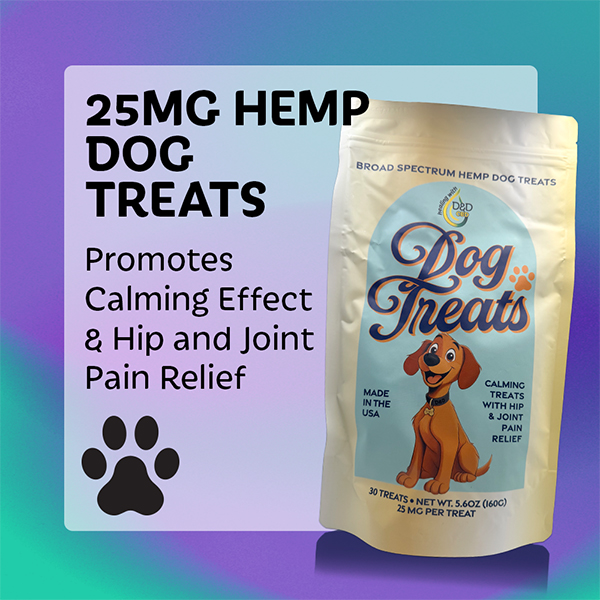
All of our products at D&D CBD, Inc. are hemp-derived and contain 0.3% THC or less, and every batch is tested by a third-party laboratory to confirm it. We don’t ask you to take our word for it — the documentation exists and reflects exactly what’s in the product your dog is eating.
This matters especially for first-time buyers who’ve heard horror stories about pets accidentally consuming marijuana products. That’s a real concern with the wrong product. It’s not a concern with properly formulated, third-party-tested hemp CBD — and understanding that distinction is often the thing that moves people from curious to confident enough to try it.
How Much CBD Should I Give My Dog — and How Do I Know It’s Working?
Dosing is where a lot of people get stuck, and it’s one of the main reasons a one-on-one consultation is worth more than a product description. That said, the general starting point used in research is weight-based: studies have used doses in the range of 2 to 4 mg of CBD per kilogram of body weight, given once or twice daily depending on the condition. Arthritis and pain relief tend to require consistent, twice-daily dosing. Anxiety can sometimes be addressed with a single daily dose or a situational dose before a known stressor — like a thunderstorm or a long day alone.
The most important principle is to start low and go slow. CBD is well-tolerated in dogs, but giving too much too soon can cause mild digestive upset. Starting with a conservative dose and adjusting over one to two weeks gives you a clearer picture of how your dog is responding without introducing too many variables at once.
Most pet owners notice something within 30 minutes to an hour after a dose — particularly for anxiety. For chronic conditions like arthritis or joint stiffness, the more meaningful improvements tend to show up after two to four weeks of consistent daily use. One of our customers noticed that her six-month-old puppy’s coat became noticeably shinier after adding CBD oil to her breakfast — an unexpected benefit that reflects how broadly the endocannabinoid system influences overall health.
If you’re in Suffolk County or Nassau County and you’re not sure where to start, that’s exactly the kind of question we’re set up to answer. Brandon Nichol — who our customers consistently describe as incredibly knowledgeable and genuinely easy to talk to — offers one-on-one consultations, in person at our East Northport location or virtually, to help you figure out the right product and the right dose for your specific dog. No guessing required.
We also deliver locally throughout Suffolk County and Nassau County, so once you know what you need, getting it isn’t complicated.
CBD for Dogs in Suffolk County and Nassau County — Is It Worth Trying?
If your dog is struggling with joint pain, stiffness, anxiety, or just isn’t the dog they used to be on walks around Northport or anywhere else in Suffolk County or Nassau County — CBD is worth a serious look. The research is real, the mechanism is understood, and the results our customers describe are specific and observable, not vague.
What makes the difference is product quality and getting the dosing right. Those two things are where most people either succeed or give up too soon. A product that’s properly tested, clearly labeled, and matched to your dog’s actual weight and condition is a very different experience from grabbing something off a shelf without guidance.
If you’re ready to have that conversation, D&D CBD, Inc. is here for it — in person in East Northport, virtually, or right at your door. Reach out, schedule a consultation, and let’s figure out together what your dog actually needs.