
If you’re living with chronic pain, there’s a good chance anxiety isn’t far behind. And if anxiety is your main struggle, your body is probably carrying that tension somewhere — your shoulders, your neck, your lower back. These two things rarely travel alone.
Most people who search for CBD for anxiety and pain aren’t dealing with one isolated problem. They’re dealing with a pattern that keeps feeding itself, and they’re tired of solutions that only address half of it. That’s exactly what this guide is for. We’ll walk through how CBD interacts with both conditions, what the research actually says, and what to look for when you’re ready to try something that might finally make a difference.
CBD for Pain and Anxiety: Why These Two Conditions Are Connected
Most wellness content treats anxiety and chronic pain as separate topics. You’ll find one article about CBD for back pain and another about CBD for stress — but very little that addresses what’s actually happening when both are present at the same time.
The connection is biological. Chronic pain activates your nervous system’s stress response. That sustained activation raises cortisol, disrupts sleep, and keeps your body in a low-level state of alert — which is essentially the physiological definition of anxiety. At the same time, anxiety amplifies pain perception. When your nervous system is already on edge, pain signals hit harder. The result is a feedback loop that’s genuinely difficult to break with single-condition treatments.
CBD interacts with the endocannabinoid system, which plays a role in regulating both pain sensation and mood. That’s why researchers have been studying cannabidiol for both conditions simultaneously. Addressing one may naturally ease the other, which is part of why CBD has become such a meaningful option for people who feel stuck in that cycle.
How Does CBD Actually Work for Anxiety?
CBD’s effect on anxiety isn’t fully understood yet, but the research has gotten more specific in recent years. One of the clearest mechanisms involves the 5-HT1A serotonin receptor — a target that many conventional anti-anxiety medications also work on. CBD appears to activate this receptor, which can produce a calming effect relatively quickly compared to some other compounds.
CBD also interacts with the endocannabinoid system by slowing the breakdown of anandamide, a naturally occurring compound sometimes called the “bliss molecule.” Higher levels of anandamide in the body are associated with reduced anxiety and a greater sense of emotional stability. This isn’t a sedative effect — most people describe it as a quieting of the background noise, not a shutdown of their mental function.
A 2024 systematic review found substantial evidence supporting CBD for stress and moderate evidence for anxiety and insomnia. It’s not a cure, and it doesn’t work the same way for everyone. But for people who are dealing with persistent, low-grade anxiety — the kind that comes with a demanding commute, a high cost of living, and a body that’s been in pain for months — the evidence is worth taking seriously.
What matters most is consistency. CBD tends to work better as a daily supplement than as an occasional rescue remedy. The endocannabinoid system responds to sustained support, and most users report that the effects become more noticeable over two to four weeks of regular use. If you’ve tried CBD once and felt nothing, dosing and product quality are usually the variables worth revisiting — not the compound itself.
How Does CBD Help With Chronic Pain?
CBD’s role in pain relief comes down to how the endocannabinoid system interacts with pain signaling throughout the body. Cannabinoid receptors are distributed across the nervous system and immune tissue, and CBD influences those receptors in ways that may reduce the intensity of pain signals and calm the inflammatory response that often drives them.
For chronic pain specifically — the kind that’s been present for months or years, whether from an old injury, arthritis, nerve damage, or a condition like fibromyalgia — CBD’s mechanism is particularly relevant. Chronic pain isn’t just a signal; it’s a pattern the nervous system has learned. The endocannabinoid system plays a role in modulating that pattern, which is why researchers studying neuropathic and inflammatory pain have paid close attention to cannabinoids.
The 2024 systematic review found substantial evidence for CBD and THC combination products for chronic pain, particularly neuropathic and inflammatory types. For CBD-only products, the evidence is still building, but the direction is consistent. Pain reduction, improved sleep, and reduced reliance on over-the-counter medications are the outcomes that appear most frequently in user-reported data.
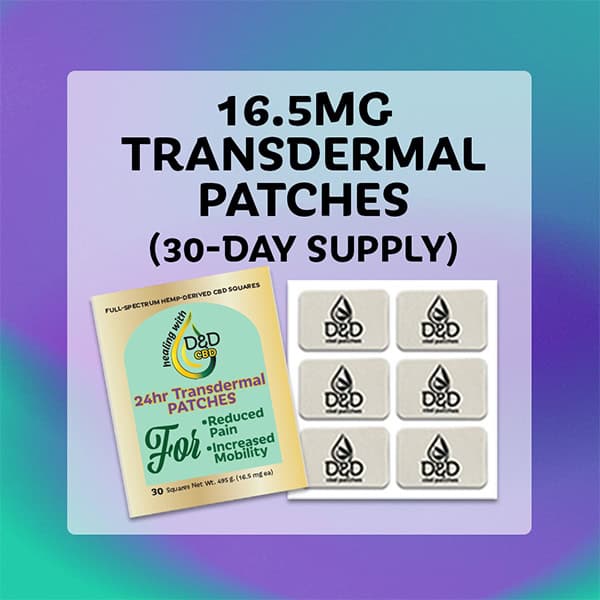
One of the things that makes topical CBD — like a salve or a patch — particularly useful for localized pain is that it allows the compound to work directly at the site of discomfort without passing through the digestive system first. A well-formulated patch can deliver CBD steadily over time, which mirrors the sustained-release approach that works best for chronic conditions. Our D&D CBD Patch combines CBD with White Willow Bark Extract, Cat’s Claw Extract, CoQ10, and Black Pepper Extract — ingredients chosen specifically for their complementary roles in pain relief and bioavailability. Wearing it daily for 30 days is where most people start to notice a real shift.
CBD for Chronic Pain and Anxiety: What Nassau County, NY Residents Are Dealing With
Nassau County residents face a specific combination of stressors that makes the anxiety-pain connection especially relevant here. A 2023 analysis by the Long Island Health Collaborative found that mental health — including depression and anxiety — surpassed cancer as the number one health concern among Nassau and Suffolk County residents. That’s a significant shift, and it reflects what a lot of people on Long Island are quietly carrying.
Add to that the physical toll of daily life: long commutes, demanding work schedules, and a cost of living that keeps the pressure on. Nearly one in five Nassau County residents is 65 or older, a demographic where chronic pain conditions like arthritis, neuropathy, and post-surgical pain are common — and where the desire to avoid opioid dependency is understandably high. The demand for a clean, non-psychoactive wellness option that addresses both the physical and mental sides of that experience is real, and it’s growing.
Is CBD Legal in New York, and Will It Make Me Feel High?
These are two of the most common questions we hear, and they’re worth answering directly.
Hemp-derived CBD is federally legal under the 2018 Farm Bill, provided the product contains no more than 0.3% THC by dry weight. In New York State, hemp CBD products are regulated by the Office of Cannabis Management (OCM). We hold two active OCM licenses — OCM-HMPD-24-01160 and OCM-HMPR-26-13111-001 — which means our products meet New York State’s compliance requirements for hemp manufacturing and retail. That’s not something every CBD seller in Nassau County, NY can say.
As for the “will I get high” question: no. Hemp-derived CBD at legal THC levels does not produce psychoactive effects. We’re positioned firmly on the wellness side of the CBD market — no smokables, no flower, no THC-dominant products. If you’re a professional, an older adult, or simply someone who wants the benefits of CBD without any association with recreational cannabis, that distinction matters. Our products are designed for people who want to feel better, not different.
For Nassau County residents who are new to CBD, that clarity is often the thing that finally makes them comfortable trying it. We’ve had customers who spent years assuming CBD was “basically marijuana” before learning what hemp-derived products actually are. Once that misconception clears, the conversation about whether CBD might help becomes a lot more productive.
CBD Oil for Pain and Anxiety: How Do You Know You’re Buying a Quality Product?
This is where the CBD market gets genuinely complicated, and it’s a fair concern. The industry isn’t tightly regulated at the federal level, which means the quality of what’s on the shelf — or in an online cart — varies significantly. A 2022 analysis found that 28% of CBD brands in the U.S. didn’t test for pesticide contamination, and only 7% tested for contaminants like heavy metals and microbes. That’s a meaningful gap between what a label says and what might actually be in the product.
The clearest signal of a trustworthy CBD brand is a publicly available Certificate of Analysis, or COA. This is a document from an independent, third-party laboratory that confirms the product’s CBD content, verifies THC levels, and screens for contaminants. Every product we sell at D&D CBD, Inc. is third-party tested, and those COAs are available for anyone to review. You don’t have to take our word for it — the lab results are right there.
Beyond testing, it’s worth looking at whether a brand is licensed by the relevant state authority. In New York, that’s the OCM. Licensing requires compliance with state standards that go beyond what the federal baseline demands, and it gives you a level of accountability that an unlicensed online retailer simply can’t provide.
For Nassau County residents specifically, there’s also real value in being able to talk to someone. Not a chatbot, not a generic FAQ page — an actual person who can walk you through which product makes sense for your situation, what dosage to start with, and what to realistically expect. That’s how we operate. Dean, Debbie, and Brandon Nichol run D&D CBD, Inc. directly, and when you reach out, you’re talking to the people who built this business. That kind of access is rare in this market, and for a first-time buyer trying to make a smart decision, it makes a real difference.
If you’re comparing options and feeling overwhelmed, start with three questions: Does this brand publish third-party lab results? Are they licensed in New York? Can I actually speak to a person? If the answer to any of those is no, keep looking.
Finding CBD That Works for Both Anxiety and Pain
The anxiety-pain cycle is real, it’s common, and it’s one of the harder things to treat with conventional approaches alone. CBD doesn’t fix everything, and we’d never tell you otherwise. But for people who’ve spent years trying medications that only address half the problem — or who are looking for a way to manage chronic pain without depending on something that comes with its own set of risks — it’s a genuinely worth-considering option, especially when the product is clean, tested, and backed by people who stand behind it.
Nassau County has a growing number of residents dealing with exactly this combination of challenges. If that sounds like you, we’d encourage you to reach out to D&D CBD, Inc. — not to be sold something, but to have an honest conversation about whether what we carry might actually help.